Invisible trail
Who are we when we write?
I’m in the last session of a brief writer’s workshop, a handful of now-familiar faces before me on a screen. They can’t see my fluffy slippers or the precarious towers of books I moved from desk to floor or the haggard impact of caregiver sleep deprivation (the right Zoom settings, overgrown bangs shading my eyeglasses, not too much light, and, voilà, presentable!).
Who are we when we write? We flip off our cameras to scribble or type out a response.
Eyes. The first word that comes to me is eyes. Then, paying attention.
Living in a mystery. Curiosity. Alone. Vulnerable. Green. Wings and tails. Moments, simultaneously ordinary and magical.
Where is the earliest story to answer this question? I wonder.
I’m 5-ish, more than a year past the fire that took my two sisters, leaving me with a mother so broken she tried, though failed, to kill herself with sleeping pills while I was napping. My father grieved by working hard, stoic and bewildered. I didn’t have those fancy words then, but I felt his world and hers. Visceral and confusing.
Not the middle girl any more. The only child now. No one to talk to, about what happened, what is still happening.
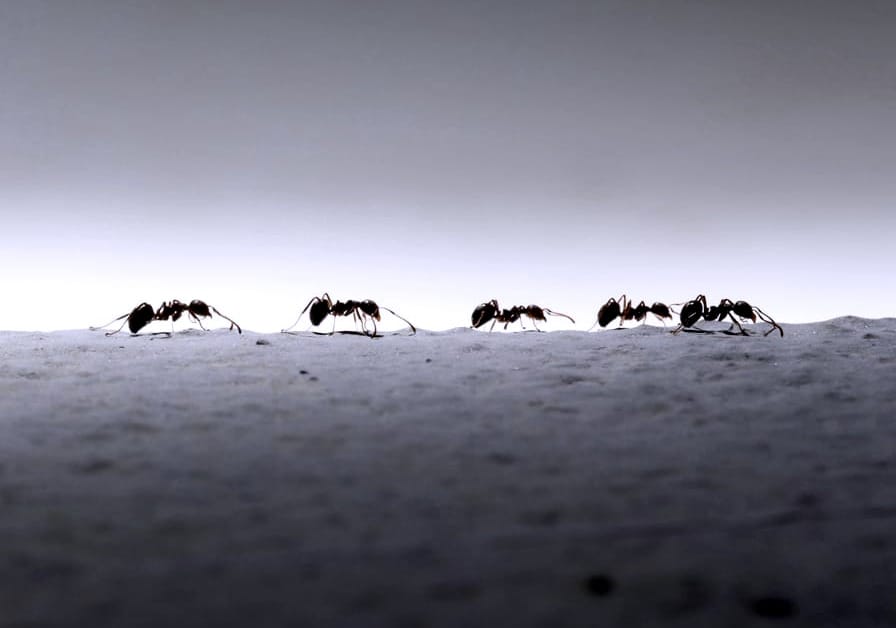
I’m in the backyard, squatting on a sidewalk. Feet bare, I feel the roughness, also the warmth. I’m looking at ants, no, watching them, like a show.
They move fast, fast, fast on their hair-like legs. Mostly they follow each other in a crooked path. If one falls out of line, or wanders off, she comes back to the ants, trotting along their trail.
There’s a ragged crack in the pavement, green growing out of it, and the ants climb through it slow and clumsy. I can see it’s hard for them getting through it, as if lost in a jungle, a tiny-to-me, but huge-to-them jungle. One by one, they make it through, all in a curving line on the other side.
A group of ants pulls apart a big, dead dragonfly. They’re strong. Like Mighty Mouse, I think.
I follow one ant carrying a long, see-through wing all by herself. Girl? Boy? I decide she’s a she. Another hauls a leaf, many times her size, the leaf toppling sideways several times, making her stop, circle it, then get it back up on her ant-shoulders, running and running.
I’m not thinking about time, about how long I’ve been looking. I’m wondering about ants. Watching as hundreds of black bodies not much bigger than grains of rice travel that path, until there are just a few.
In the garden, there’s a little hole next to a wilting flower, among orange petals in the dirt, and the ants go in. They disappear.
Where are they when I can’t see them? What are they doing in that hidden place?
When I think all the ants are gone, one ant pops up on the sidewalk. No other ants to follow, but she finds the invisible path and scuttles along, tracing it perfectly over pavement, through the jungle, heading toward the orange petals.
I sense that even though she seems lost and alone, she really isn’t. She’s following the invisible trail to her others. I don’t know why, but I feel happy and safe.
After writing this memory, I’m surprised at how it came to me into this moment, into this writing-reflection exercise, without effort or invitation. I experienced it, lush with detail, felt in body as much as in the mind. Yes, that was the conversation I needed then, spoken through the natural world, wild and sensory. Still that way now.
Who am I when I write?
I am that last ant who senses the invisible trail that’s always leading to the hidden place, ordinary and magical, always keeping us connected to our others, whether we see them or not. Writing is how I make the trail visible to myself and to anyone who wants to come along with me.

Member discussion