
Moon joy
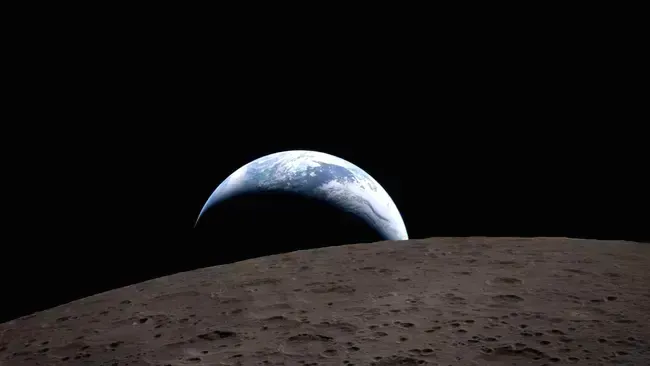
“I would like to remind you of one of the most important mysteries on Earth, and that’s love. And to all of you down there on Earth and around Earth, we love you, from the moon." – Artemis II Pilot Victor Glover, speaking from the Orion module on April 6, 2026.

Later today the crew of the Artemis II moon mission will plop down in the Pacific at the other end of my state. Reid Wiseman, Victor Glover, Christina Hammock Koch, and Jeremy Hansen, our newly famous moon tourists, will be safely back on Earth.
As with life itself, the beginning and ending of a journey can be the most challenging. I’ll be watching the landing with optimism but also a tinge of apprehension, because leaving and returning to a planet involves so many tiny as well as huge technical phenomena to all go right.
So much of our population arrived after men walked on the moon in 1969, and with the International Space Station hosting rotating crews for 25 years, the idea of four people being flung at the moon and back in just 10 days doesn’t seem as remarkable to many as it does to me.
I was working on another essay and some shorter pieces, when on April 1, my mind went to the moon.
With war and politics and the personal life ‘stuff’ each of us navigate, we need a giddy group of explorers who describe themselves as “a bunch of kids up here” and end a dialogue with “Copy. Moon Joy.”
So below, I’m sharing a piece about wonder, space & time, and that earth mystery that Astronaut Glover talked about, love.
My father had a secret moon.
Standing here in the light of a full moon, where a feather caught in pebbles and the beetle that clambers over it are visible, I feel exposed in this midnight moment, sleepless and disheveled, as I think of my father and his moon.
Two tiny moons look back at me from the edge of the woods. The eyeshine of a she-fox. She’s sitting, sweet as a dog, looking at me.
A sky full of clouds that have been drizzling down, and suddenly this opening, the mottled white face of the moon as if another kind of fox, luminous, looking at me.
No, a rabbit, I think, remembering the old Chinese tale of the woman and the moon rabbit who live in the moon palace. The woman, Chang’e, drinks an elixir that gives her immortality, but realizing she will outlive her husband, she flies up with her rabbit to the moon as her eternal home, lonely yet free, where she can stay forever near her husband in the heavens.
Looking back at the moon, my eyes trace the outlines of its grey patches, and there he is, moon rabbit.
There are more than a woman and a rabbit up there.
As the clouds shape-shift, opening up portals of purple-black sky stippled with stars, I imagine four people encapsulated in aluminum, silica, titanium, and carbon—the Artemis crew in their Orion module about the size of the travel trailer I lived in as a kid.
I'm smiling. The image of that long-ago trailer bobbing and sailing in a limitless, dark universe zips through my mind, crazy-impossible and crazy-possible.
Tiny, vulnerable, a bubble of curiosity, they are four humans breathing into a space where no body has gone, no heart has inhabited with it’s two-beat rhythm.
Drops of rain, a wet curtain, and the sky closes over me. Back in bed, drifting into sleep, I feel them orbiting—the astronauts and my father—then a phrase, earth angels.

My father had a secret moon.
That thought first arrived as I watched, via the telly, the Artemis II, preparing to launch from NASA's Kennedy Space Center. News cameras panned across thousands of people clumped together or lining up in spots throughout Cape Canaveral to witness the first crewed lunar mission in 50 years, excitedly staring, scanning, waiting, smiling, pointing.
A flashback. I know those places. I stood beside my father more than once as a young girl watching rockets launch, missions my father contributed to, all unmanned though some meant to dock with a crew once in orbit.
Mostly research vessels intended to pave the way for the 1969 moon walk, those rockets carried scientific cameras that my father helped engineer, field test, and calibrate, capturing new facets of the earth and the moon.
It was a time of geopolitical competition, a space race fueled by the Cold War and an old colonization mindset, both aimed at staking out orbital turf, claiming the moon, then Mars, and no doubt every planet, star, and galaxy, if possible.
So, my father could tell us very little about what was, and still is to me, his trailblazing moon work.
But once, he gave us a glimpse.
Even as true to his confidentiality oath as he was, he was also a man who left a troubled home at 17 without a high school diploma, and worked wildly hard to land himself in a room of engineers aiming for the moon. Some pride is earned and meant to be shared.
One evening he came home to the long, tin, breadbox-on-wheels that was our trailer, which allowed us to follow him from site to site as he worked on various space camera projects. Though he must have been tired, he was animated, giddy. I’d rarely seen him that way.
He motioned my mother and me to the laminated dining table, as he closed the curtains. Then he unlocked a black suitcase that he sometimes carried between work and home, pulling out a large, goldenrod envelope. As we leaned in, curious, he flipped over the envelope, undoing its string closure in a figure-8 pattern.
The moment seemed slow yet dramatic as kid.
As he started to pull something out of the envelope, he paused, his voice low, saying. “This is secret, okay?” My mother looked at me, then we both looked at my father, nodding.
Slowly he pulled out a black-and-white photo, perhaps 8 x 10 or a bit larger, until it lay, magical, on the table. A yellowy-white, cratered moon, floating against black. It was taken by one of his space cameras.
This photo may not sound like much to you, reading this decades past that moment, but it was, as a little girl in that time, akin to dreaming of flying only to wake and realize you are actually flying.
The moon had risen and glided across our table. The moon was something you could hold.
I couldn’t see the man in the moon, but there was my father, a man, with his own secret moon.
My mother tucked me into the other end of the trailer, behind the tall curtain that served as my bedroom ‘door.' I listened to her set down a supper plate for my father, the tap and clatter of his fork, and the soft bubbling of my parents’ voices until I fell asleep.
The next morning, I suddenly remembered it was show-and-tell day at school. While my mother packed my lunch, I looked around the trailer for something interesting to take.
Not another stuffed animal or storybook or polaroid of my Westy dog or the Navajo doll I got in New Mexico. Then, I spied the golden envelope. It stood-up at the end of the table next to one of my father’s ties, and I layered it into my workbook. My mother spun around, handing me my lunchbox, kissing me on my forehead, and off I went to school.
Needless to say, I had the best show-and-tell that day, and the coolest dad. When I stepped up into our trailer mid-afternoon, my mother was frantic, grabbing my school stuff, rifling through it all, until she found the envelope in the workbook.
I’d forgotten the ‘secret’ part of my father’s moon. I wasn’t afraid of a spanking. I was sad to think of disappointing my father.
Like many nights, it was dark when he came home. I waited behind the curtain of my room, expecting anger, until he called me to the table.
Was he upset? Yes. Angry at me? No.
He explained what I’d done was a bad thing for me and for him. I understood that he could get in trouble if others found out his secret moon turned up in an elementary school, but that wasn’t the bad thing at all.
The conversation orbited around promises. Around a daughter not keeping her promise, but also a father not keeping his promise. As he talked, his blue eyes fixed on mine, there was, no kidding, the glow of moonlight coming through the window behind him, making a halo around his head, casting tree-shadows on the table.
The moment was baffling to tiny me. That there was only this conversation, without punishment. This teaching, this revelation about my father whom I couldn’t imagine ever did anything wrong, this connection between two flawed humans whose sense of wonder and pride outweighed a promise.
Of course, I didn’t mentally process the conversation that way, but I felt it in my fidgeting, fledgling body. A girl getting wiser. A father being honest and patient. How light moves around and between them, connecting them to each other and to a universe so big that an eye or a camera will never see it all.
Memories are rockets in their own right.
If you’ve ever grieved the loss of someone you love, you know what it feels like to be launched into longing and despair in an instant. Perhaps when a certain scent that was theirs arrives uninvited or you pull a slip of paper with their scrawl from an old coat pocket or their song starts in the middle of the produce aisle.
Whenever I hear the songs, “Moon River” or “I Did It My Way,” the words might as well be, Your father is never again going to be sitting across from you, his blue eyes looking into yours, at that funky trailer table.
But. It works the other way, too, right?
Four people crammed in an 11-foot by 17-foot capsule, sitting a top a 322-foot-high Artemis rocket system, takes you on a ride. Let’s you time travel. Let’s you feel how much you were loved, have always been loved, will always be loved by that one, irreplaceable, unreplicable person.
As the Artemis II took off, a column of fire burning it up into the blue, emblazoning the crew into history, there was another flashback.
Following it’s orange plume higher and higher, memory eclipsed moment, and suddenly I saw a fireball and flaming pieces of rocket dropping down toward the Atlantic.
It looks like a sparkler. A thought, but also the words of a 6-year-old, holding her father’s hand.
Looking up at him, something I’d rarely seen, tears, his cheeks flushed.
“Is it supposed to do that, Daddy?”
He shook his head slowly back and forth, and I understood, no, and to stay silent beside him.
Minutes earlier that rocket, called the Atlas-Agena, had stood on the launchpad, a silvery white needle pointing to heaven, shimmering at us across the river where we watched from a special area for project engineers and their families.
White clouds had burst around its base, the earth rumbling under my feet and in my ears, a quaking rising up through my body, the way the rocket rose though humid air.
Unlike the Artemis II, which puts a rocket under a crew in one complex launch, the Gemini 9 involved two launches, the Atlas-Agena rocket and the Gemini crewed capsule.
The Atlas part of the rocket was the flaming muscle, pushing the nearly 100’ rocket up with enough force that the Agena could separate and reach orbit around the earth. Then about 90-minutes later, the Gemini would launch and ‘chase’ the Agena to dock with it, so that the men could practice space walks and other exercises that would support future moon shots.
I didn’t know any of this back then. It would take a few days before my father could calmly explain the anguish I’d witnessed. Months of long hours and detailed, technical work had been lost in less than 2 minutes. It wasn’t just the camera he’d poured himself into, but as if a part of him had failed and fallen in the sea, too.
It was a lesson in the perils of holding on too tightly to your work or letting your work hold on too tightly to your identity. Alas, I would need to learn that lesson on my own in time. Like father, like daughter.
But there was more. He explained that two men had been waiting in the Gemini capsule ready to launch when the mission literally fell apart. The starkness of how dangerous space travel could be if the failure happened with human beings inside, brought me to tears as he spoke.
He and his space cameras would go on to other successful missions, traveling longer and farther, and one night he would come home to his wife and little girl, sharing his secret moon.
Do you have a secret moon moment with someone you love? Can you summon and savor it now?
Thank you for being a part of my world.
If you took away something from this issue that feels meaningful to you, please forward this email of the Wild Now to others who might feel the same.
If this issue was forwarded to you and you'd like to read more, you can explore and subscribe at WildNow.Life.



Member discussion