On leaves and leaving
Life has a way of echoing. Have you noticed that?
It might be discovering a new song or learning a new concept—have you figured out 6-7 yet?—then hearing it seemingly everywhere. It could be numerical, like 222 or 7:11, or symbols–dragonflies anyone?—grabbing your attention in weird places.
Sometimes it's a challenge you're working on or a project you're exploring or a threshold you're stepping through in one area of life, only to have the experience echo in other areas of your life.
Surprise, you are living a theme, or in your own private season that has nothing to do with time of year or the weather.
Living with loss is one of those landscapes that often sprouts and takes root on multiple levels and in uninvited ways. That ever happen to you?
For what it's worth, living with possibility or joy or curiosity can also be welcome echo-chambers, though we might need to be more intentional in planting the seeds for those.
The piece I'm sharing below for this issue of the Wild Now, explores these ideas. I hope you take away something supportive.

On leaves and leaving
Early spring, and I looked up one afternoon at the Japanese red maple by the front door to see new maroon leaves, drifting to the pavement. One, then another, my eyes following them down. Little red hands on the sidewalk as if some child had been crawling and suddenly disappeared. Small, stark, ruddy dark on white.
Leaving. That’s what I felt. More leaving.
Leafing, leaves-fling, leaving. My mind at play, as three more young, vibrant leaves let go.
Looking up again, so many branches were either entirely bare, or aiming curled brown fists at the sky. Anger crumbles, I thought. Better to go down as flames, a cranberry-brilliance, the hands wanting to touch earth, even cemented earth, one more time.
Right now, I am standing under this maple, gazing up, as if looking through a skeleton. Is this what it’s like to be a carrion fly or corpse beetle arriving at a new, silent body in the woods, immense and empty?
Half of the tree is bald, half still lush, luminous with sunlight through full red leaves, along with a few winged seeds, dangling, like promises that everything will be okay.
What sad magic is happening here?
I love this tree. Not in the flimsy way of I-love-this, I-love-that, when you really mean you like or admire or are really fond of something. I love this tree, the way I love a certain circle of beings who’ve come to inhabit my life, who see me at a time when I feel terribly invisible.
May I tell you about this tree?
More than a woody presence with outstretched arms in the garden—petite as trees go, yet bigger than me—for 17 years it’s been among the first to greet me through the window each morning, and many evenings I’ve said, “Good night, my friend.”
You don’t realize what simple things sustain you day-to-day. This tree has meant constancy, especially on days or whole seasons of fragility.
Several Christmases ago, when I realized my husband’s health meant we weren’t going anywhere, I moved some of the holiday lights from the front of the house to this tree, adorning its winter-naked branches with light, a cheeriness, that my husband could see from his recliner.
Each December, dressing the tree with lights, then in the dim dawn and dark night, pausing with tea or a glass of wine, I’d whisper, “You are lovely, my friend, thank you.”
I believed, and still believe, the tree felt loved and honored and truly seen, as it did the same for me. That is a kind of joy you need to notice.
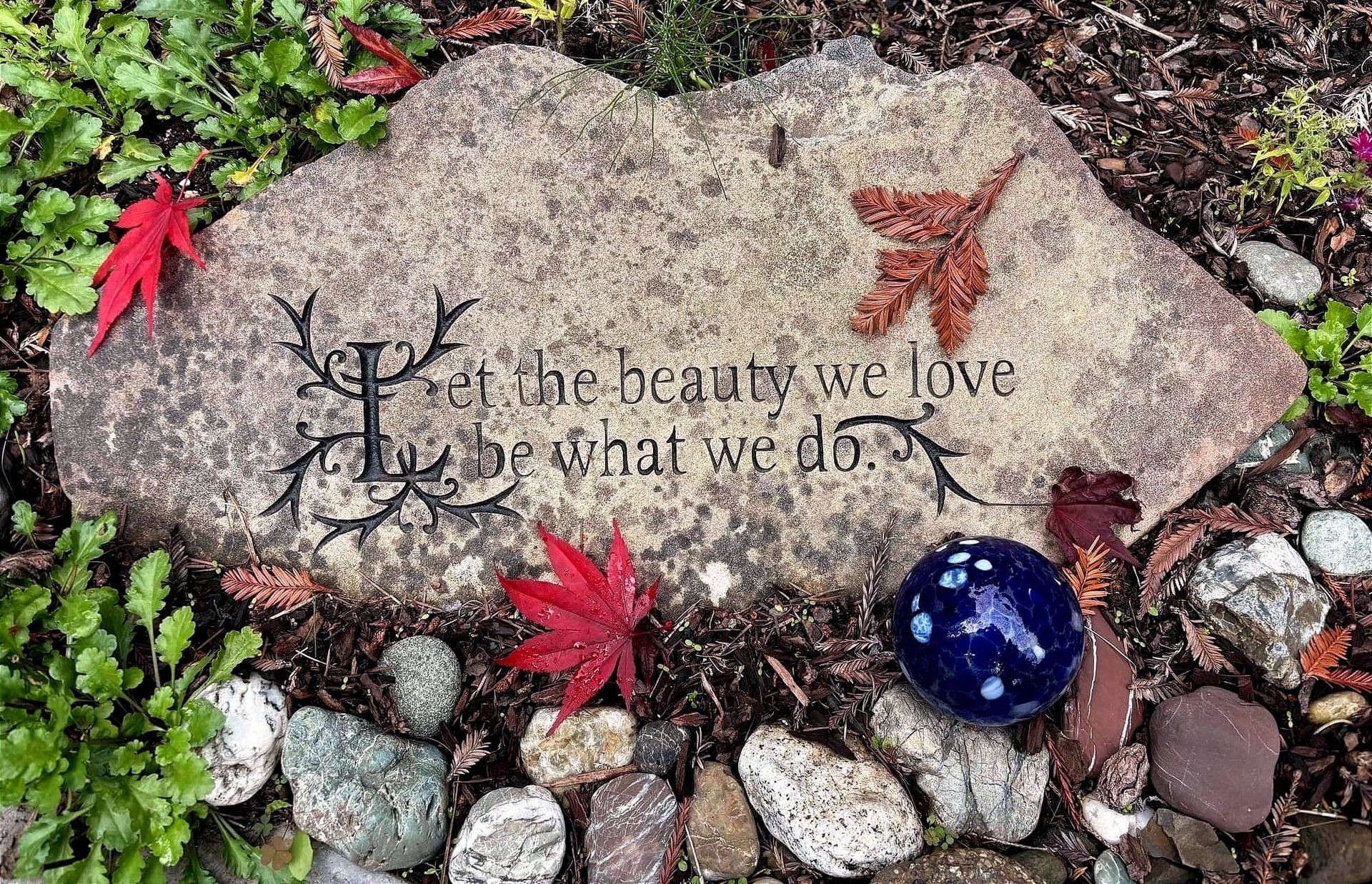
Gifts from friends over the years hang in the limbs, holding our friends close, right there, just outside the door. A colorful, hand-blown glass ball, even at the stillest hour, sways from one branch. On another, a rusty bell, shaped like an owl, makes a clatter when it storms. And there, a bronzy-metal pine cone, the newest addition, flashes like a lighthouse with all the new sun the sparse branches now let in.
I love this tree. This tree. This specific Japanese red maple that lives with us.
The arborist has just been here. Kind as well as knowing.
We were introduced through the hospice program several months ago. A volunteer. The social worker hoped he could visit with my husband so I could get away for a walk, for an hour or two each week, without worry or responsibility, but my husband would have none of it.
Dying often makes a person’s world small, so small, there’s no room for new others. Safe, energy-sparing, even if lonely.
“Let me know if I can help in any way in the future,” this man offered. I held on to those words.
Asking for help is hard, even after so many years of solo caring for someone you love on a long end-of-life journey. Asking is another thing to do on an already overwhelming list of things that need doing. Asking feels like a burden, vulnerability, defeat, risk.
Still, it seemed like pure synchronicity, or what one Jewish friend would call bashert (meant to be), that a hospice volunteer would be a professional arborist, arriving in my tiny cosmos before I knew I’d need an arborist, when I’ve never in my life known an arborist. I mean, what are the odds?
After digging around in the roots, clipping a dead branch, inspecting the bark, touching the tree’s body, certain nodes, thinking, the arborist returned tools to his black, tree-doctor bag then turned to me.
His face, sober, I could feel root-deep in my body how he didn’t want to say to me what he nevertheless had to say. Doesn’t every doctor want to be a savior, or at least, hopeful?
He told me what my AI chap, Claude, had already prepared me for, after I’d uploaded photo after desperate photo.
My maple-friend is dying. Yes, of course. And why not now?
Nothing really to do but tend to what is still living, keep a sliver of hope that the tree may revive for a while, maybe one last partial flourish, and prepare to say goodbye.
“Oh,” I told him, “That’s something I know well how to do.”
Not yet done with life
we practice leaving a path—
crimson hands, green hearts.

What do you love that is also leaving?
If something in this issue of the Wild Now landed for you, I'd love to hear about it via private email or using the comment button below. (I read all responses, though please give me a couple-few days to respond, okay?)


Member discussion