What if you are walking in stars?
Do you find it's harder these days to know what's real?
In recent weeks, a few former clients reached out to me. Some are juggling the emotional tangles of personal loss, months or years or even decades after 'it' happened. Grief suddenly and perplexingly inflamed.
Others feel lost in a hamster wheel of thoughts, not just persistent and confusing, but also, and this is important, usually not true. The mind is full of so many voices, including some that are terribly unkind and depleting. It can be hard to hear the one that really belongs to you.
I've been feeling it, too.
What I realize, though, is that what's happening in the outer world can really mess with what's happening in our inner world. Faraway wars and disingenuous words make it hard to know what to believe, what's real.
Because we are porous beings, it all enters into us.
Here's the question to ask: What else is out there? What if I let that in?
There's a song that popped up in my eclectic music feed that I've been listening to. It resonates. You might think it's a sad or cynical song, but no. It's about the act of resilience—not easy, but real—by creating a garden within (indeed, a mind garden is what I often recommend).

Joy is an American singer-songwriter of Nigerian parents, taking up the guitar at age 10 upon seeing a Tracy Chapman video.
Yes, there is a place in the world for action. For some it’s on the front lines and for others, in a literacy program. For many, tending that inner garden with intention and love is what's doable right now.
That inner garden is the only thing that's kept we humans going—for ourselves and for each other. Our superpower isn't opposable thumbs but opposable minds.
Now, to this week's piece, a three-part story about stars, a bear, and the little surprises that sustain us. Grab a cuppa something and settle in.

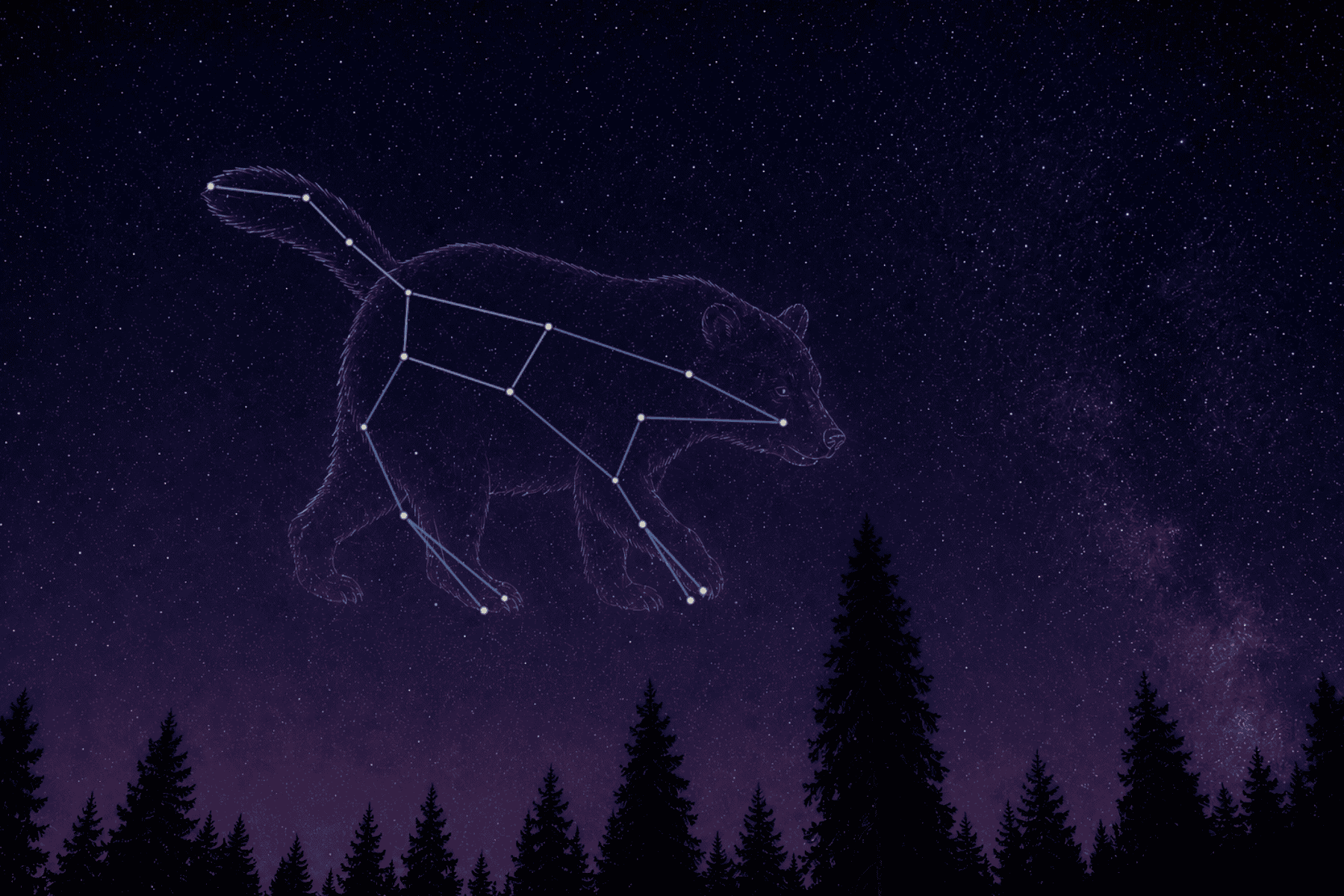
Before pen and paper, people looked up, and in the stars, they saw a bear.
The nights were deeply dark then. The bear, a luminous, forever-form, pacing through the northern skies month-to-month, year-to-year, brought calm, certainty, when the days felt chaotic and fragile. Hmmm, have the days ever not felt that way?
Hard to trust that you would wake from the tiny-death of sleep. Whether you did or didn’t, the bear would still be there, waiting for you.
Looking up now, unless you are far from porch lights and street lights and the blue-glow of living room windows where we watch curated stories on screens instead of the wild dramas unfolding in the great out there, mostly you see only the bear’s bottom, the curved string of stars, her tail, which we know as the handle of the Big Dipper.
My niece as a toddler once asked me, “Where do the stars go at day time?”
Her child-voice arrives in this moment as the sun pushes its first glimmers past the horizon, trickling between tree trunks.
Looking down at my feet in lush spring green, I see stars scattered amongst sorrel and sprouts of violet leaves. Stars as bright as that old night bear.
My long-ago answer was accurate, “The stars are here, you just can’t see them during the day because the sun is bright. So, the stars are always here.” I could see in the smooth, perfect skin of her face and the way she squinted at the milky sea of Pennsylvania sky spilt over us, she wasn’t buying it.
Now I wish we were both the people we were then only right here.
I would say, “At night we look up, but when it’s day, you need to look down and around.” I would point to our bare feet, wet in this May world of weeds and wildflowers emerging, saying, “See all the stars. We are walking in stars.”
Yes, I could explain how sunlight gets tangled in beads of water, what’s left of this morning‘s fog, how each becomes a dazzling reflective lens, glittering all around us. She’d have that same blue-glistening in her eyes, not at all believing the physics of it, but trusting the visual, visceral evidence: We are walking in stars.

I have bears on the brain.
Spring is slowly unfurling, and bears coming out of winter, even the mild, coastal one we had here, can be rambunctious.
Food is still not in full flush, so they’re hungry and increasingly creative and daring in filling their bellies. Then if you happen to be a young adult bear, not as big as you will be, but also no longer a mama’s boy, you not only need to bulk up, you need to start exploring, staking out your own territory.
A sub-adult bear is not much different than certain sub-adult humans, which might mean behaving like a bad-ass.
This spring there’s one such bear. I’ve nicknamed him, Rebel Bear.
Already he’s torn open the door to my husband’s workshop where, for the last 9 uneventful months, I’ve been keeping the tightly sealed, plastic compost bucket that the local “Worm Guy” business picks up and replaces every two weeks.
Did I tell you how much I love thinking about feeding the Worm Guy’s worms?
I imagine their naked-pink glee at our banana peels and pear cores, my peachy and cinnamon tea grounds, the fallen petals and wilted leaves of Alstroemeria, bits of leftover cat food, the pasta my husband asked for but whose failing appetite prevented him from finishing, and the occasional moldy berries. Worms are the ultimate recyclers, turning discarded, organic gunk into compost for growing more life-sustaining edibles and blossoming wonders, some of which become gunk again. It’s the circle of life that isn’t a song yet. Okay, story for another day.
Did I tell you what a mess Rebel Bear left?
Fact: Rebel Bears are pickier than worms, so they don’t eat grapefruit rinds or cucumber skins or whatever wet rot used to be. They do, however, eat Alstroemeria petals? So I can’t really be upset with a bear who is made in part of flowers.
Much better than anger or fear is curiosity.
Before the workshop attack, I spent a quiet, wind-less dawn watching a distant, taller-than-others, redwood tree, dancing. The tree, I mean. While I’ve been known to dance at dawn, that morning it was this tree bouncing and shimmying.
Let me back up. Before watching, I was listening.
First, it was bark crackling, a scraping-ripping sound, as if it was being torn away, then the tumbling of pieces falling through limbs, and the crunch when it found ground. It took me a bit of angling for the right position on the deck to follow the bark music through the woods to that landmark tree.
I’m not good at guesstimating heights, but that tree has to be 75-100 feet tall. I was first drawn in by the enormous branches more than halfway up, shaking, bobbing, a buoyancy moving around deep in the tree, front to side to back, down a bit, up a bit. The whole tree was quivering, all the way to its tip top.
Searching for a subtle thermal or oddball current, some wobbling in the needles or leaves of others, turned up nothing. The world was still—every tree, shrub, fern, all suspended, like me, perhaps trying to make sense of this timbered dancer.
I ran into the house and grabbed my binoculars, then back out, scanning as the flailing and throbbing of the branches moved up and up. I just couldn’t see any body in that tree.
A tree ghost? Some old spirit-being rummaging through the redwood for what it may have left behind, the way we might look for lost keys or coins in the couch?
My first thought was a Black bear, but this limb movement was so high, up, up, up, eventually two-thirds up. I considered a bunch of plump, clumsy Band-tailed pigeons, but no. Fidgety turkeys? No. Could a Fisher climb that high? We’ve seen them here, though it's been years. Mountain lion or bobcat? Seemed unlikely, they’re stealthy.
This mystery animal sounded heavy.
Patience. Something the invisible beastie and I shared.
I waited for he or she to let themself be seen. Finally, the dancing reached high enough where I could see a furry body in an open space that exposed the tree's trunk. Surprise, my first instinct was right.
A Black bear! Through my binoculars, the bear, who I decided was likely an adventurous he, pulled at the bark, sometimes pawing and snapping away smaller limbs, then licking and biting at the trunk.
I had no idea a bear could or would climb so high in a huge tree.
I’d later read that, while rare, immature bears can overestimate their prowess, get risky with their reaching, and fall to their deaths. Mostly, thankfully, they don’t. While bears arose from some long-gone doggish ancestor, they tend to fall like cats—startled, but after a good shake, ambling off gallantly.
Why are you licking the tree? Insects, larva, tree wound oozing sap, just an itchy tongue?
Don’t know how long I watched the bear show—part aerial love affair, part bold bruin ambition.
Eventually, I went inside to my laptop and dove down a bear hole of natural history and research on tree licking and quirky ursine spring behavior. Ah, this bark-stripper was seeking a sugar high.
Digging below the bark of that dancing tree, Rebel Bear was going after the cambium, a layer (just a few cells thick) between the inner bark (called phloem) that transports sugars to feed new growth and the sapwood, the tree’s pipeline for pulling water up from the roots. Cambium is sappy-sweet and caloric, and any insects or larva caught up in the gorging are like sprinkles on a cupcake.
Smiling, I went to the window where I could see the dancing tree. Pulling my left leg up, rooting its foot flat inside my right thigh, I assumed what in yoga is called, Vrksasana, that is, the Tree Pose. Once balanced on my right foot, I lifted my arms up and slightly out, as if branches, then closed my eyes.
Focusing on the tension between sway and balance, my mind wandered like another kind of bear.
Skin and bark. Such a kinship between my small, fleshy, human frame and that ascendant redwood, being licked and nipped by a young bear.
A human has her layers. The visible skin, her bark, is both porous and protective, and always dying, even as she goes on. Her version of cambium, a few layers deep and juicy-dense with glucose, would be a nice bear dessert.
Sleeping, my husband calls out my name, asking, “What happened to the people visiting? Did I miss them?”
“Well, depends, who are you thinking about?” I reply.
Silence. He’s sleep-thinking.
“I’m not sure who they were? Were they here for me?”
“Oh, them,” I say, “They haven’t come yet. No worries, you didn’t miss them. I’ll make sure to let you know when they arrive, okay? You get some rest now, so you’ll feel ready when they come.”
Silence. He’s done asking. Now solitude.
Well, not alone, not really. There are shadows subtly edging sideways over the dresser, tinting a pair of ceramic harbor seals, caressing a wooden comb, as the light of a partial, clouded moon seeps through the windows.
More and more, as my husband plods along his end-of-life journey, he lives in dreaming awakeness. It’s become part of our days, too. He asks me to answer doorbells and urgent knocking. Wonders who the visitors are, roaming somewhere in the house. Worries about when he’s supposed to be some place, and how he only wants to go if I can go with him.
It’s 2:34 am.
Something magical about sequential time: 2.3.4. Not a countdown, but a progression toward whatever’s next.
Did I bring the seed and suet feeders in tonight?
Dang, my mind is certainly awake.
A few weeks ago, a bear bent a steel bird feeder arm into a U. Standing on an old redwood stump below our deck, he was guzzling seeds and trying to free a suet-cake from it’s little cage. So until the spring-bear crazies pass, best to bring in before bed what would otherwise be bear bait.
Slipping on shoes and robe and fleecy trousers, I head into the living room. One cat is a furry nautilus burrowed into my berber jacket left on the couch. The other is in my husband’s recliner—she’s slightly snoring, laid out like a dark bowling pin, wide rump to stretched-out front legs.
Looking through the sliding glass door to where the bird and suet feeders should be, nothing.
Nothing thanks to me, or nothing thanks to Rebel Bear?
As I step out onto the moonlit deck to look over the railing for the feeders, from below, out rushes my Black bear friend.
We’ve startled each other.
He’s loping down a trail so fast, then leaping sideways, that mostly all I see is his ample bear bottom as it disappears into a group of small, lushly leafed-out cascara trees.
Nice to see you, too, Rebel Bear, my mind calls after him.
In my chest, my heart is loping down its own inner trail a bit.
Alive.
I feel alive. Thank you, Rebel Bear.
After a few snaps, rustling through ferns and saplings in the forest below, he’s gone.
Peaceful.
In the distance, a Northern pygmy owl announces himself, a calibrated whoot, whoot, whoot, whoot, whoot. Two frogs in the pond out front croak to each other then stop, croak and stop, several times as if a game.
There’s the calm trickling of water, bubbling and constant, in the recirculating steam.
What time flowing by sounds like if you could hear it.
Such a lovely thought—I’ll put that in the journal when I go in.
Thinking of the quick glimpse of Rebel Bear’s bottom, I look up.
A dark window opens in the clouds, and there, the Big Dipper, though I see not its handle, but the bear tail of Ursa Major.
I search and squint to see the old glowing sky bear, find her outline in the stars. But a thin, high-up veil of fog mutes the shyer points of light. It takes memory and imagination to map the rest of her, and when I do, such a happy realization.
Her face is pointing to that dancing tree, whose dark, quaking mystery turned out to be a sweet-seeking bear.
What is the difference between a star-bear and flesh-bear?
I go to the glass door of our bedroom, and looking in, see the ridge beneath the comforter that is my husband’s body, still here, lost in sleep. I don’t doubt his visitors are real.
Real. Such a burdened word, carrying the weight of: solid, touchable, material.
But no. Real, at its heart, acknowledges only a sense of thingness, which could be wonder or grief, or what a shape in the sky or in a tree or in your mind signifies.
Real is stars crossing the sky all night then constellations scattered, twinkling, in wet leaves at your feet come morning.
What is something that's real to you even if you can't touch or fully explain it?
If something in this issue of the Wild Now landed for you, I'd love to hear about it via private email or using the comment button below. (I read all responses, though please give me a couple-few days to respond, okay?)

Member discussion