What unspoken agreements carry you forward?
It's tempting to say I can't believe February is almost over and that we're about to step into March with its lion-ish fame. But I won't.
Of course I believe it. In a time when so much seems unsettled and change is happening at breakneck speed, the calendar is such a wonderfully dependable friend. Don't you agree?
In this issue of the Wild Now, I'm sharing two Field Notes from this week. The first echoes that sense of reliability as one season begins its turn toward another, while the second takes the conversation off on a different path, a longer evolution of ideas, that utterly surprised me.
This "where did that come from?" experience is the alchemy of writing and the mind colluding on the page. As the Tom Hanks character, Forrest Gump, would say, it's "like a box of chocolates. You never know what you're gonna get."

🌱 Field Note | February 24, 2026
Beneath the arms of a redwood, within it’s limbs hanging down, it is not the rain that finds me, those pearls stringing down from the grey-clotted sky.
Rather, like the way of oiled water slipping down a loon’s back, the tree takes in the world first then hands it down to me, drop by drop, as I squat looking for what’s left of a tiny wild lily I stole from a friend.
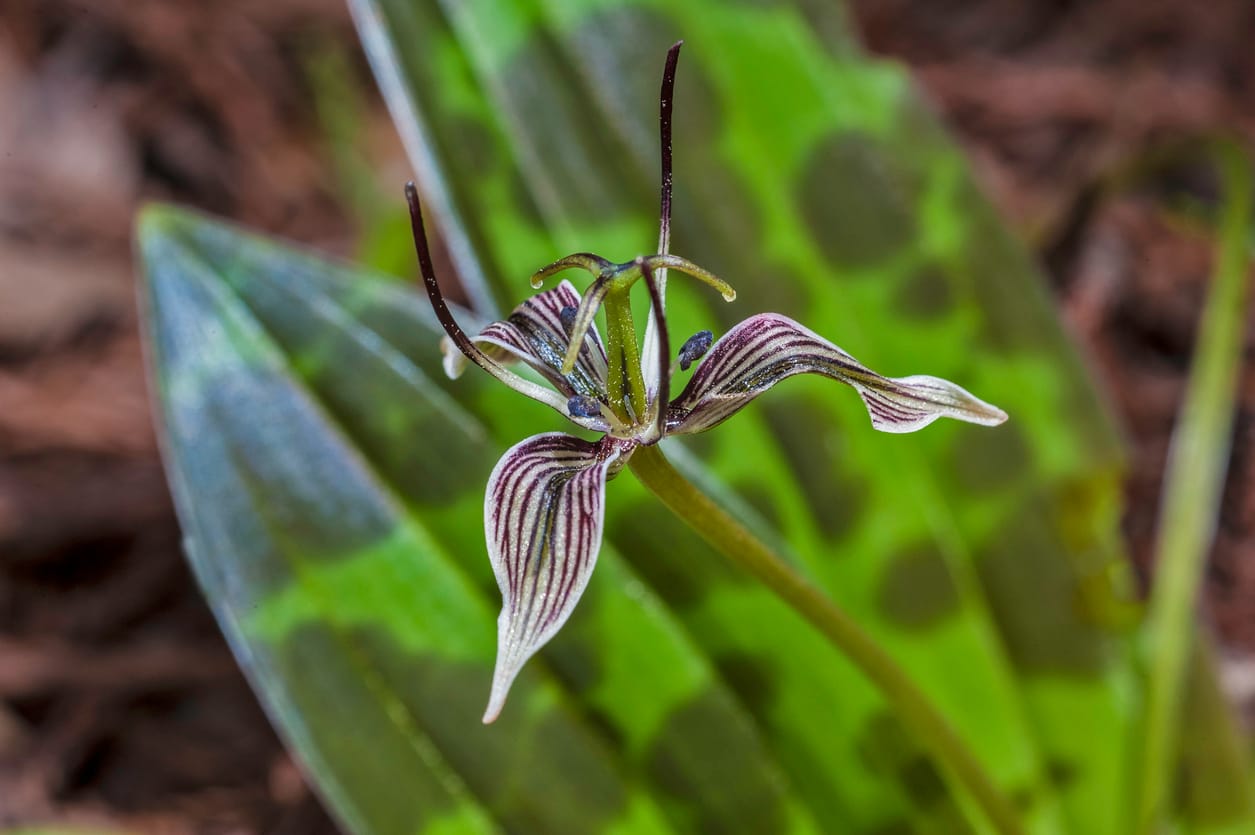
Fetid adder’s tongue. A horrible name for a flower, for the delicate stem and the three burgundy-striped sepals, little fluttering scarfs in suspended animation.
It sprouts a little earlier each year since I planted it beneath this redwood nearly 17 years ago.
Blooming for more than a month now (which is odd but happy), the speckled leaves have grown big as my palm. They eclipse the threadish stems, some still standing, most drooping, all headless, except for a single blossom holding on for one more day. I see you.
A grey puff, a little cloud surging and swaying around its stamens, is in fact a cluster of black specks, murmuration of minute insects, fungus gnats, that you would never notice unless you crouch as a toddler, bending spine and head into curiosity, or balance as a women wanting joy, willing to find it anywhere.
The redwood towering over us, more leaky hut than tree, feels safe. This gnatty cloud hovering, undulating, fluid, is a show, a rain dance. I listen for gnat music, some call and response from the damp flower.
Crackling, tapping, there is only the collision of falling water finding forest and wild floor.
The fetid scent is for them, the gnats. Like an old marriage, the flower and the flier have a relationship, an understanding, part love, part truce. The gnats sip a secret nectar. The flower loads flecks of yellow pollen onto wings.
Seen or not, this is how everything goes on, spinning through season after season. You and me, too.
Every moment an agreement, yes?
🌱 Field Note | February 26, 2026
What do we agree to?
Last night a 2-year-old video clip in the news feed: a baby pulled crying from war rubble. For every 5,000 human beings lost to bombs, we’ll give you a baby like this. Twenty pounds of hope for each five or ten thousand tonnes of steel and TNT.
That's one agreement, even if the war-makers and media didn't give us a voice.
With recent rains, the tree frogs have returned to sing in the pond. I certainly agree to that.
Each night, having cracked the bedroom windows, I wake and lie listening to all the little frogs, their happy longing.
When I first moved to this home in a redwood clearing, the frogs arrived earlier and sang all spring. In recent years, they arrive later and fewer, their singing lasting barely a month at best.
To get more of some things—clever devices and gadgets, boxes at the doorstep, easy beef and avocados flying the globe, artificial intelligence we think can answer all our questions—we agree to less of other things.
Tree frogs in your pond, for instance, and families for those babies.
Ah, too somber, think as I write. What else do we agree to?
- Pay taxes for decent roads and teaching our kids to read.
- Say “I’m sorry,” so we don’t lose each other.
- Stop at red lights to let all get home safely.
- Bring bags to the grocer’s, not only to haul home heads of lettuce, but starve fewer sea turtles of plastics in their bellies.
- Listen, so we each have our stories heard and know we matter.
- Show up to vote to ensure power circulates instead of calcifies.
- Keep on loving the people we love not in spite of their flaws and frailties, but because of our own.
We forgive ourselves in great part by forgiving others.
Years ago, travelling in Sierra Leone, a decade past that country’s convoluted and brutal civil war—hmmm, how can any war be civil?—I met with a village chief, several really, but one returns to mind in this moment.
I’d been told by my Freetown colleague, Fataba, who was leading me through her country, not to ask about the war unless a local brought it up.
As I sat with that village chief, he told me how so many young people grew up through the war, thinking violence was an ordinary response to life, the cutlass and the Kalashnikov the way you answered anyone or anything you didn’t like, or a fear you felt but didn’t understand.
His words, that conversation, come back to me now, in bits, gauzy yet real.
“After the war,” he explained, “we were afraid of our children.”
“At first, we sent the children, returning to the village, away. The boys turned child soldiers and the girls, stolen and abused as war wives, we sent them away. There was no trust.”
“But how do we go on?” he asked, “This village, our people, without children?”
“One boy came back. I did not recognize him.” This man’s voice became quieter, slower.
“When he said he was my brother’s son, I did not believe him. I knew my brother’s son. I thought both had been killed. Then he said a story of me, and when I looked into his eyes, I finally saw it was him.”
This chief had witnessed his village burn and his people flee over splayed bodies into rainforest, before he, too, abandoned what had been home.
As he talked, he was surrounded by other men who bore thick, ridged scars running cheek to ear, or motioned with missing hands, sometimes entirely absent forearms. A few embodied the kind of deep sadness that makes eye contact hard, leaving them to look at their feet just to stay safe in the midst of memory.
“When I went to embrace the boy,” he continued, “tears behind my eyes, so happy I was to have him back, he pulled away from me, jumping backward, almost falling.”
The chief paused, brushing his sleeve over his glistening forehead—a hot, humid afternoon in the upcountry of Salone.
“This boy. Who knows what terrible things he had seen, he had done? He had no trust for me.”
The chief went on to explain how that meeting was the turning point of accepting the war children back into his village, taming the violent minds and volatile emotions, helping them reinhabit the peaceful hearts children are meant to have.
One thought from that weathered, hopeful leader, from that afternoon together, sharing his story, has stayed with me for more than a dozen years.
“I thought it was only I who needed to trust. No. Trust is an agreement. And you must first agree to respect each other’s fear.”
What agreements run through your life that support bits of joy, or perhaps don't, that you need to renegotiate?

Thank you for being a part of my world.
If you took away something from this issue that feels meaningful to you, please forward this email of the Wild Now to others who might feel the same.
If this issue was forwarded to you and you'd like to read more, you can explore and subscribe at WildNow.Life.
Member discussion